About LLM Compressor
LLM Compressor is an easy-to-use library for optimizing large language models for deployment with vLLM, enabling up to 5X faster, cheaper inference. It provides a comprehensive toolkit for:
- Applying a wide variety of compression algorithms, including weight and activation quantization, pruning, and more
- Seamlessly integrating with Hugging Face Transformers, Models, and Datasets
- Using a
safetensors-based file format for compressed model storage that is compatible withvLLM - Supporting performant compression of large models via
accelerate
 LLM Compressor
LLM Compressor 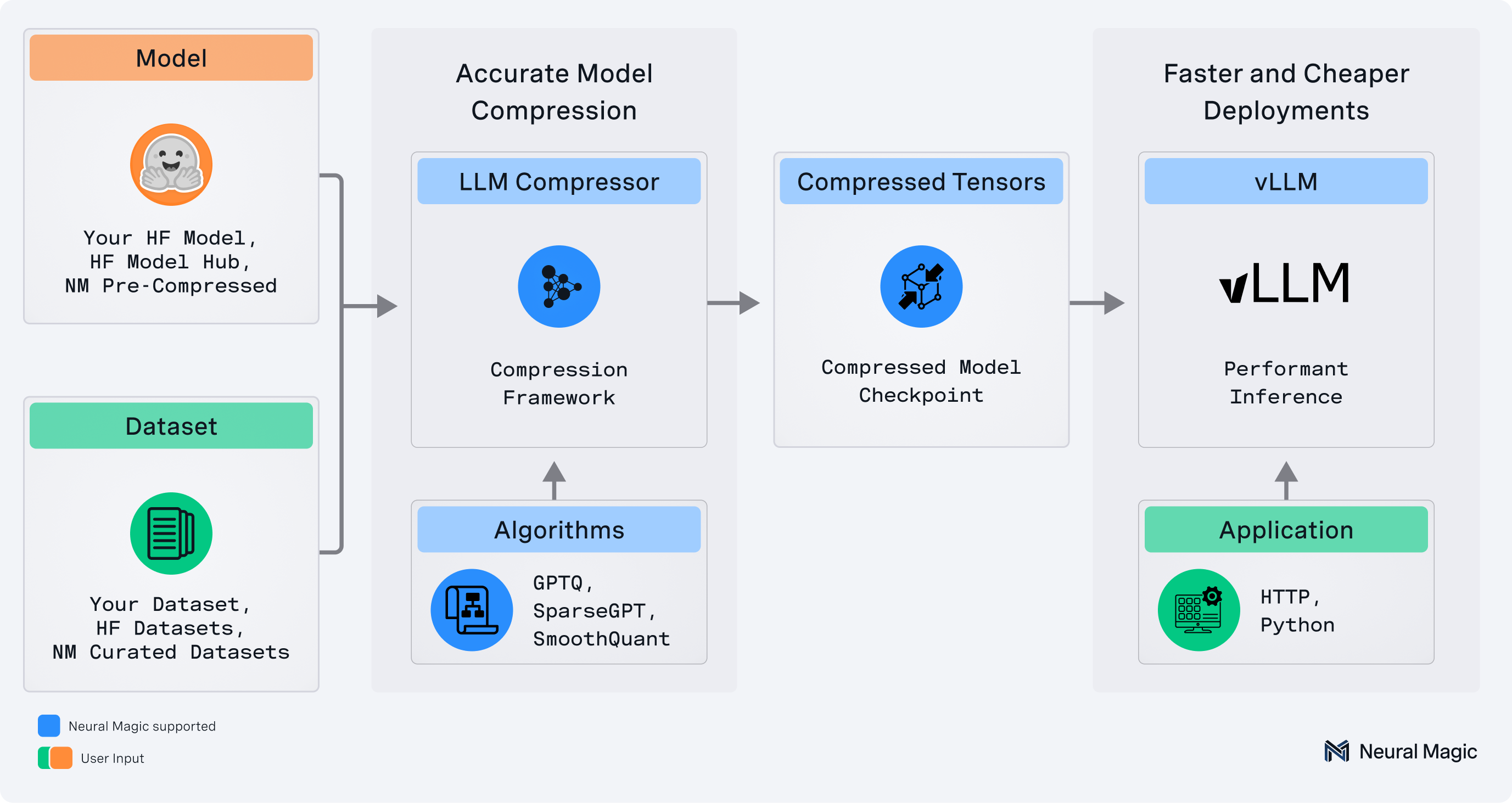
New in this release
Review the LLM Compressor v0.8.0 release notes for details about new features. Highlights include:
Support for multiple modifiers in oneshot compression runs
LLM Compressor now supports using multiple modifiers in oneshot compression runs such as applying both AWQ and GPTQ in a single model.
Using multiple modifiers is an advanced usage of LLM Compressor and an active area of research. See Non-uniform Quantization for more detail and example usage.
Quantization and calibration support for Qwen3 models
Quantization and calibration support for Qwen3 Next models has been added to LLM Compressor.
LLM Compressor now supports quantization for Qwen3 Next and Qwen3 VL MoE models. You can now use data-free pathways such as FP8 channel-wise and block-wise quantization. Pathways requiring data such W4A16 and NVFP4 are planned for a future release.
Examples for NVFP4 and FP8 quantization have been added for the Qwen3-Next-80B-A3B-Instruct model.
For the Qwen3 VL MoE model, support has been added for the data-free pathway. The data-free pathway applies FP8 quantization, for example, channel-wise and block-wise quantization.
NOTE: These models are not supported in tranformers<=4.56.2. You may need to install transformers from source.
Transforms support for non-full-size rotation sizes
You can now set a transform_block_size field in the Transform-based modifier classes SpinQuantModifier and QuIPModifier. You can configure transforms of variable size with this field, and you don't need to restrict hadamards to match the size of the weight.
Recent Updates
QuIP and SpinQuant-style Transforms
The newly added QuIPModifier and SpinQuantModifier transforms allow you to quantize models after injecting hadamard weights into the computation graph, reducing quantization error and greatly improving accuracy recovery for low bit-weight and activation quantization.
DeepSeekV3-style Block Quantization Support
Allows for more efficient compression of large language models without needing a calibration dataset. Quantize a Qwen3 model to W8A8.
FP4 Quantization - now with MoE and non-uniform support
Quantize weights and activations to FP4 and seamlessly run the compressed model in vLLM. Model weights and activations are quantized following the NVFP4 configuration. See examples of FP4 activation support, MoE support, and Non-uniform quantization support where some layers are selectively quantized to FP8 for better recovery. You can also mix other quantization schemes, such as INT8 and INT4.
Llama4 Quantization Support
Quantize a Llama4 model to W4A16 or NVFP4. The checkpoint produced can seamlessly run in vLLM.
For more information, check out the latest release on GitHub.
Key Features
- Weight and Activation Quantization: Reduce model size and improve inference performance for general and server-based applications with the latest research.
- Supported Algorithms: GPTQ, AWQ, SmoothQuant, RTN
- Supported Formats: INT W8A8, FP W8A8
- Weight-Only Quantization: Reduce model size and improve inference performance for latency sensitive applications with the latest research
- Supported Algorithms: GPTQ, AWQ, RTN
- Supported Formats: INT W4A16, INT W8A16
- Weight Pruning: Reduce model size and improve inference performance for all use cases with the latest research
- Supported Algorithms: SparseGPT, Magnitude, Sparse Finetuning
- Supported Formats: 2:4 (semi-structured), unstructured
Key Sections
-
Getting Started
Install LLM Compressor and learn how to apply your first optimization recipe.
-
Guides
Detailed guides covering compression schemes, algorithms, and advanced usage patterns.
-
Examples
Step-by-step examples for different compression techniques and model types.
-
Developer Resources
Information for contributors and developers extending LLM Compressor.