P-EAGLE
P-EAGLE (Parallel EAGLE) extends Eagle-3 with parallel multi-token prediction. Instead of drafting tokens autoregressively one at a time, P-EAGLE predicts multiple tokens in parallel. It uses Conditional Drop-token (COD) sampling during training for memory efficiency, and Llama-style transformer layers inherited from Eagle-3. It can be paired with any supported verifier model.
How It Works
Architecture
P-EAGLE builds on the Eagle-3 architecture: the target model produces hidden states at selected layers, which are concatenated, projected, and passed through Llama-style decoder layers. The key difference is that P-EAGLE adds multiple prediction depths -- at each position, the model predicts not just the next token but several tokens ahead in parallel. Each depth level d makes predictions for position (anchor + d) in the sequence.
COD Sampling
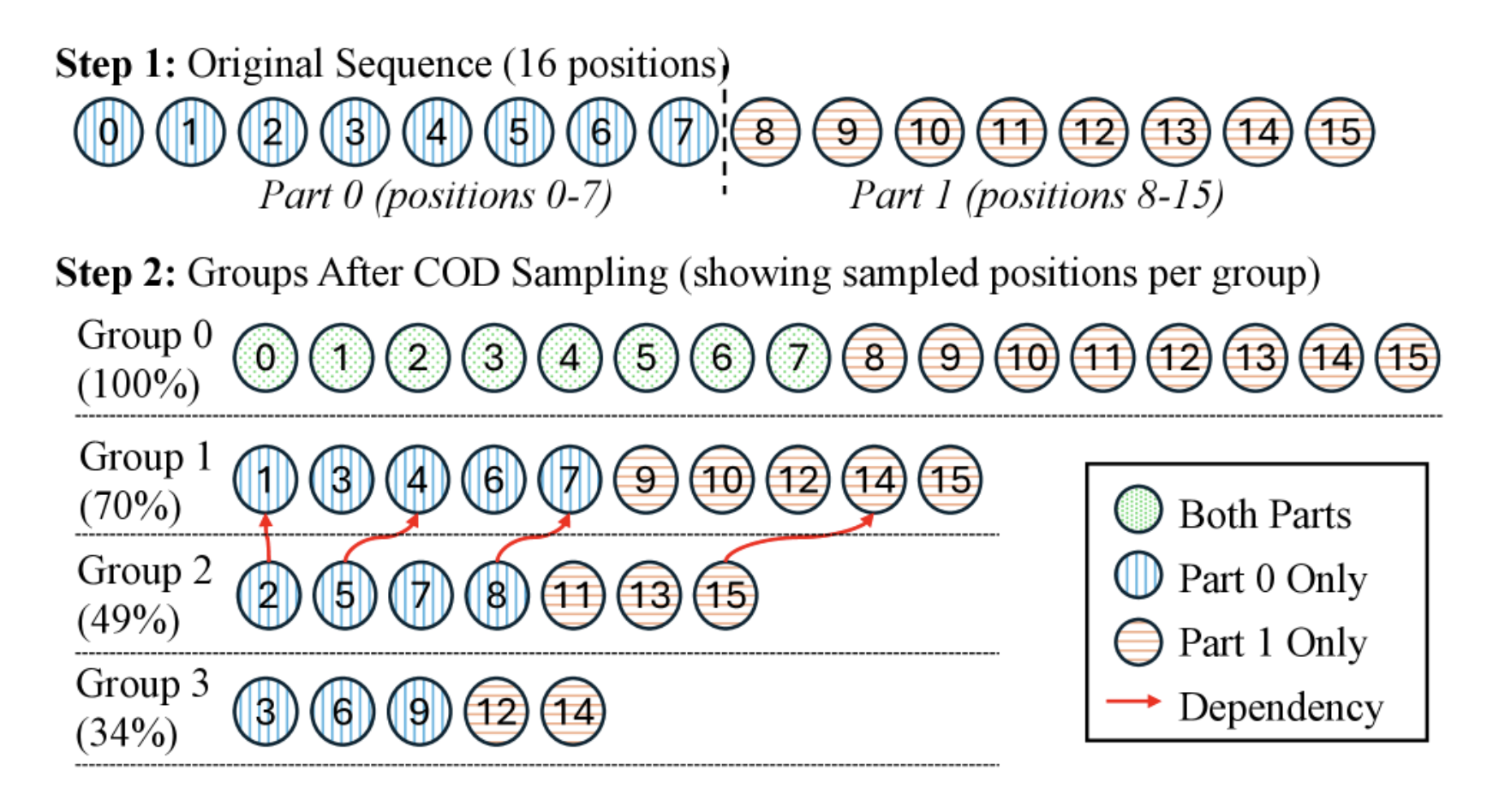
Training a parallel multi-depth model naively would require memory proportional to num_depths × sequence_length. P-EAGLE uses Conditional Drop-token (COD) sampling to reduce this cost:
- Depth 0 retains all n positions
- Depth d retains approximately n × r^d positions, where r is the
down-sample-ratio - A minimum retention floor (
down-sample-ratio-min) prevents over-sampling at deep levels
This geometric decay means deeper predictions train on fewer positions per batch, keeping memory usage manageable while still learning to predict multiple tokens ahead.
Inference Process
- P-EAGLE drafts multiple tokens in parallel across all depths in a single pass
- Target model verifies all draft tokens in one forward pass
- The longest correct prefix is accepted
- Repeat from the last accepted token
Key Parameters
| Parameter | Default | Description |
|---|---|---|
--num-layers | 4 | Number of draft transformer layers |
--num-depths | 4 | Number of parallel prediction depths |
--down-sample-ratio | 0.7 | Geometric decay ratio for COD sampling |
--down-sample-ratio-min | 0.2 | Minimum retention floor for COD sampling |
--no-norm-before-residual | — | Disable normalization before residual connections |
Pretrained Models
There are currently no pretrained P-EAGLE models available. You can train your own using the tutorials linked below.
Research & Citation
P-EAGLE is based on research from AWS AI Labs: arXiv Paper
@article{hui2026peagle,
  title={P-EAGLE: Parallel-Drafting EAGLE with Scalable Training},
  author={Hui, Mude and Huang, Xin and Salas, Jaime Campos and Sun, Yue and Pemberton, Nathan and Song, Xiang and Khetan, Ashish and Karypis, George},
  journal={arXiv preprint arXiv:2602.01469},
  year={2026}
}
See Also
- Train P-EAGLE Offline -- Offline training tutorial